Long time no write, I know! We arrived in New Zealand on 23 October 2025, after an exciting trip from Tonga via the Minerva Reef where our motor died after becoming fully filled with water. The starter motor’s gears shattered and little gear teeth filled the housing. But, as Magnus says, if you know you don’t have a motor, you can plan for it, and we had a great arrival into NZ. The Bay of Islands Marina harbour captain met us and towed us into the “Q” customs dock, then towed us over to our berth after we cleared in. We had super support from the Gulf Harbour Radio team, with extra weather updates for us on our way in, and even the NZ coast guard came and checked us out upon arrival to see that we were making our way in. NZ gave us a fantastic welcome.
Our trip from Sweden has been almost three years long at this point. In Sweden, there are great chandleries in marinas and towns all along the west coast, and what isn’t in stock is easily mail ordered. Since that was what we knew, we expected to find similar service along the way. Unfortunately, that wasn’t at all the case. Sourcing spare parts is a major challenge of long sailing trips, and you can’t bring along spare parts of everything (but we do try).
The best local chandlery after Denmark was in Gran Canaria, where they were used to outfitting the ARC boats. After that, there were some ok chandleries in the Caribbean, but scarce availability and the costs were exorbitant. Even in Panama, where sailboats gather and live year-round, there weren’t well stocked chandleries available like we were used to in Sweden; and costs were still extremely high. Across French Polynesia, the availability of chandleries and even shipping options was even worse. When we landed in Tahiti, we thought we would be able to source parts, and it turns out that they had almost nothing we needed. Even the Volvo exclusive dealer didn’t have parts for our Penta engine.
Sailors help sailors, and people going to places with easy availability of parts often are willing to carry small parts back for other sailors; or friends who have family visiting can have them bring small things. However, they usually also need lots of things themselves and just don’t have space to help for bigger items. We have had friends bring us back small items from Sweden and been very thankful. But along the way, we had a growing list of things that needed attention, and nowhere to take care of them. Even to service our motor in Tonga, we had to have oil filters flown in from Australia, because we couldn’t buy them anywhere between Panama and Tonga.
Image our happiness at arriving in New Zealand and discovering that they have really well stocked chandleries, just like in Sweden 🙂
So Lulu has been having a lot of maintenance and service done, things that we would have replaced along the way if we had been able, but which just weren’t possible due to the lack of access or extremely high cost of getting the parts. What follows is a catalogue of updates and maintenance that Lulu has needed after three years of sailing.
On Deck:
New Mainsail, new genoa, replaced sun protection on jib. Maintenance on the swivels including lubrication on all, repair work on the genua swivel. New whisker poles. New flag lines.
The sun ate our old sails. The laminate genoa was disintegrating and had rows of small holes between the stitches, so we switched to our spare genoa which began delaminating into tissue-paper thin layers. The main became thin and also stretched, so it was getting wrinkled which led to small holes. We kept the main as an emergency spare, and the other sails were sadly thrown away. While Magnus was climbing the mast to work on the swivels, we took the opportunity to replace our flag lines and the pulley system to hoist flags.
Our whisker poles broke when the halyard broke and our Tradewind sail dropped into the Atlantic back in 2023. Magnus made emergency repairs, we weren’t able to order new poles until Puerto Rico but Seldén first delivered the wrong parts then couldn’t deliver the correct parts at all. We had the help of a rigger to repair the inner tubes, but it was a patch job and the twice repaired poles were fragile and slightly bent. So for the first time since 2023, we were able to order the correct replacement poles for our downwind / Tradewind sail.
New running lights in the bow, new netting along the lifelines, replaced dorade vent cowls, new portable solar panels including a new charger and new thicker electrical cables. Re-caulking / re-sealing the two window hatches.
The sun, waves breaking over the deck, and just living on a boat cause wear and tear. The dorade vents were dirty back in Sweden, and we haven’t seen new cowls anywhere until NZ. They degrade in the strong sunlight, the plastic seeps out a sticky covering which can’t be cleaned off. The sun also eats through the caulking / sealant on our window hatches on deck, and they need to be re-caulked / re-sealed at least annually.
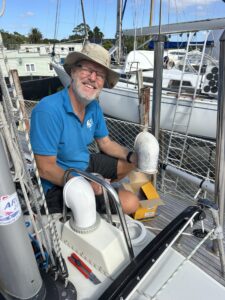
Our bow running lights had seen one too many waves, the netting was damaged both by getting on and off the boat plus the blocks used when we run the downwind sail. Our 200w portable solar panel still works, but it was a bit long and was often shaded by the shrouds. Magnus found a pair of smaller 160w each panels, which were less shaded as they were a bit shorter, and which would give better charging without having to be moved around the boat. He upgraded the charger so that it could accept more than 200w, and drew thicker electrical cable for both the portable panels and our main 415w glass panel. Additionally, he sawed off the poles on our mounting platform for the solar panel, so they don’t shade the solar panel anymore. He fitted caps onto the sawed off poles, to keep water from running into the boat, as they go below deck into the lasarette / garage.
The Cockpit
New sprayhood with an openable window and rain drape, new sheet bags, new chairs. Plotter repair. New main sheet system. New life vest for Jodi.
Our old sprayhood was becoming threadbare with sunlight shining through the threads, as well as was very speckled with mold spots that wouldn’t was off. Something that was new for us with downwind sailing was also that it rains into the cockpit – from behind you. It’s not possible to duck under the sprayhood and get out of the rain, because it is raining from behind. So we added a clear curtain that allows us to sit in the cockpit without getting drenched; and it has the added benefit of allowing us to keep the cockpit open in rainy weather in warmer climates instead of having to close everything down. Additionally, we had an openable window added in the front, because when you are at anchor it is nice to get a breeze in the evenings.
Our deck chairs had been repaired a couple times by Magnus, he figured out that he could cut up pool noodles and use them to cushion the frame which extended their life a lot. But the fabric was wearing out and we were afraid the frame would damage the teak in the cockpit. After looking for new chairs since the Caribbean, we finally found them in NZ. Also, we have used the sheet bags in the cockpit to store sunscreen, sunglasses, phones, knick knacks. They were disintegrating and little bits of plastic were constantly littering the cockpit. Despite ordering the identical make / model of bags, the manufacturer had changed the placement of the mounting brackets, so we had to drill new holes to mount them.
Our Raymarine plotter has been having aging issues for several years; forgetting settings that we make so we have to re-enter the settings every time we use the plotter, having problems calibrating the touch screen, and most recently showing incorrect GPS data. So Magnus found an identical unit with different problems, and is building Frankenstein’s plotter from the two. The memory chips are known to have problems, and Magnus tried sourcing a memory chip when we were in the US and Sweden over the winter holidays, but it turns out the information he had on the chip was incorrect and the chip he had with him didn’t work. This is still a work in progress. Magnus re-sealed the area around the instrument panel with butyl gum, which allows him to remove the items without destroying the seal.
Our main sheet system had small metal fatigue areas which Magnus had repaired very nicely, but seeing how important the main sheet system is and how much stress it can be subject to, we ordered a new system to replace it and picked it up when we were in Sweden at Christmastime. The old sheets can be used as emergency genoa sheets, so we saved them.
Jodi also got a new coastal life vest (our offshore vests are still in good shape). The old one was looking pretty awful, they get stained by sunscreen and sweat, and we actually wear life vests whenever we sail, even in coastal / calm waters. We have three sets – offshore with MOB and all the bells and whistles (literally whistles!), coastal inflatable and coastal permanent flotation. The latter ones are great when sailing in cold weather as they can be worn under your gear for an extra insulation layer, the inflatables are cooler in the warmer climates as they don’t sit so close.
The Engine
We have been having engine problems for ages and have been fixing the symptoms because we didn’t know the root cause until it died outside the Minerva Reef. Our exhaust system didn’t have a backflow valve, and when we had the wind in from the port side and were heeling to starboard, the exhaust allowed water to flow into the engine and fill it. This also could happen because Lulu has a low freeboard, and just doesn’t have the height necessary to get away with not having a backflow valve. Magnus found a backflow valve in the US (they didn’t have them with Lulu’s dimensions in NZ!) and installed it plus changed the routing of the exhaust hose so it goes through the centerline of the boat instead of along the starboard side.
In addition to that, Magnus took the fuel injectors to a specialist workshop and had them cleaned and adjusted; and finished rebuilding our new starter motor to have two poles / match the prior starter motor polarity. The marine shop where we ordered our starter motor kindly rebuilt the old motor when they couldn’t source a two-pole starter motor; but since he had already bought a new single pole motor, he kept the rebuilt old one as a spare.
The Dinghy
Our dinghy has also seen some improvement, Magnus sewed a new bimini cover to replace the old one which was disintegrating from sunlight. It also had small bits of plastic flaking off the underside of it, and we don’t want to add plastic waste to the ocean. The outboard motor got a new propeller and a motor service.
Below Decks
Our freshwater pump got serviced as it gets a lot of use, Magnus adjusted the air pressure and checked the system. We pickled the watermaker when we arrived in NZ, and started running it again when we left Whangarei. It is running with great ppm values, but has a bit uneven pressure at start-up so we are monitoring it carefully. Magnus has previously serviced the whole system in Panama, but doesn’t want to open it up again unless absolutely necessary, as it causes wear on the system just to be opened. It’s great to have our own water again, we really don’t like buying water in bottles but the tap water doesn’t always taste good at marinas.
Our toilet is electric, and Magnus also installed a new impeller to keep it working well! We even added some glycerine to it to lubricate it when we used it on land. (yes, possible – another story). When we were preparing to launch and greasing all the through hulls, the handle on the one to the toilet broke off. So Magnus replaced it, and we bought an extra one in the size that the inlet valve for the motor. We don’t open and close the other through hulls that much, so we thought that if one of them had a problem, it would be the one that wasn’t opened very often; instead of the one we use the most.
Under the boat
Lulu needed new anti-fouling, mostly because we did such intense scraping before coming to NZ. They have very stringent biosecurity here, and all the cleaning actually wears off the anti-fouling. So we added on 4 layers, hoping to not have to haul out in Australia next year but being able to go a bit longer. We also raised the waterline to the bottom of the topmost stripe, and currently don’t have any stipes. We might add them, but Lulu looks very nice as she is right now, so not a priority. All the spare parts and stores mean that we sit really heavy / low in the water!
Regular maintenance at haul-out includes polishing the propeller, and all the anodes were replaced including in the bow thruster. Our propeller also has small rubber “spacers” at the base of the blades, which we were able to replace. There are two thin steel rods around our propeller, protecting it from fishing nets and logs and the like. We hit a large log outside of Panama, and the rods did their job and protected the propeller, but they were loosened and Magnus tightened them up and re-mounted them.
But wait…. There’s more!
You might think that there isn’t much more to service here, but… it’s a boat.
On our to-do list are:
Have our life raft serviced
Repair the gear shift cover
Adjust the mainsail – warranty update with sailmaker (it’s just a wee bit too long)
Ongoing maintenance
Prepare for next long passage back to Minerva and Fiji
Thank you for reading, if you’re still there then I am impressed! Signing off from Cracker Bay Marina, Auckland NZ on 2026-March-30.